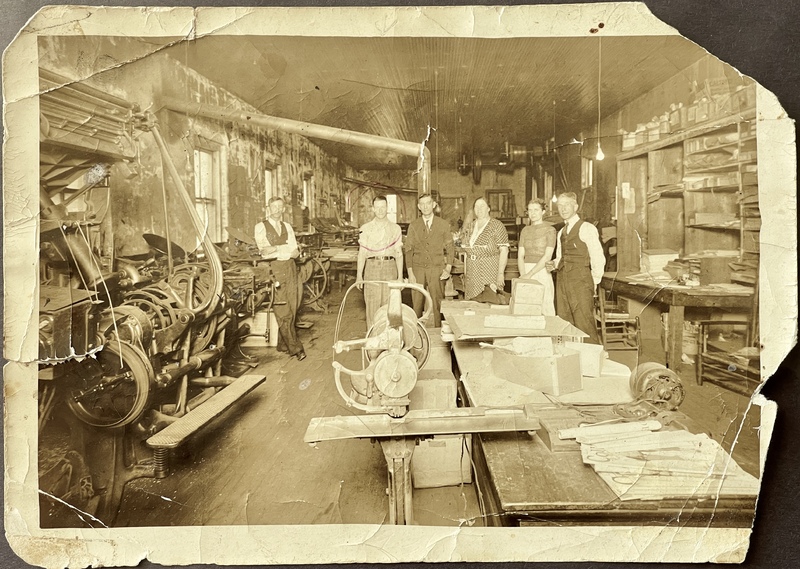
The Greer Citizen The Greer Citizen was the longest-running of Greer's four newspapers; its first issue published on May 10, 1918.
Greer had several newspapers in its early years. Those that are known include:
• Greer Observer began publication about July 1, 1905, operated by a stock company with "ample financial backing." Professor J. M. Moore was the first president, and editor of the paper. Dr. George Cureton was business manager, and Edwin Bailey (son of the first mayor) was treasurer. It suspended publication 1913-1915, then ceased operation in 1918. Its office reopened as Greer Citizen.
• Greer News-Leader was established in 1910 by a group of 10 men as a Democrat-viewpoint paper. That group included M. C. "Cliff" Davenport, son of D.D. Davenport, and he became president of the paper. It began semi-weekly, then went weekly after 1912. It ceased operation by 1915.
• Greer Citizen was founded May 10, 1918. P. W. Smith purchased the defunct Greer Observer and reopened it as The Greer Citizen.
• Greer Tribune and the Industrial News was founded as an Independent-Democrat weekly paper in 1924. It ceased publication in 1935.
FOUNDING
The Greer Citizen was founded as the Greer Observer in June, 1905, and began publication around July 1. It ceased publication about 1915; it might have had a very short-life restart under new owners in 1917. In 1918 the building and equipment were purchased by Preston Webb (P. W.) Smith and then reopened as Greer Citizen with first publication on May 10, 1918. According to business records currently in possession of Smith descendants, P. W. Smith purchased equipment on April 13, 1918 from R. H. DeYoung, who had worked under Remsen. Greenville Daily News, May 2, 1918, reports that the Greer Observer weekly newspaper, which had not published for many months, had been purchased by W. P. Smith [sic], “a newspaper man of considerable reputation,” who had moved from Williamston to buy and operate the paper. The former editor, Lieut. N.C. Ramsey [sic], had been stationed at Camp Jackson (possibly the reason for the paper stopping). That was actually N.C. Remsen, who ended up as a captain and served overseas.
The May 23, 1929 issue of the Greer Citizen has, in the masthead, "Founded May 10, 1917." There are other sources that state the founding of the paper was May 10, 1917 as well. In a history of the paper written by Carol Dixon working with Charles P. Smith (son of of Preston, and who worked at the paper), Charles recollects printing a special issue at the end of the Great War "on the morning of November 11, 1917." This would indicate that the paper existed before 1918, except for one detail: the Armistice was on November 11, 1918. The Smith papers provide original-source documentation establishing the 1918 date, and the Greenville Daily News article provides secondary confirmation.
According to Charles P. Smith, son of the founder, the Citizen was started "because of the need for it — especially the need of the merchants."
That first year there were approximately 700 subscribers; that number grew to 2,200 by 1937 and 10,000 in 2006.
OWNERS, PUBLISHERS AND EDITORS
— Professor J. M. Moore was the first president and editor of the Greer Observer.
— McClain: a July 1922 newspaper article states that the first editor was a young lawyer named McClain.
— J. Marion Moore: editor of the Greer Observer by June, 1906. Moore was simultaneously the superintendent of the Greers Graded School.
— Charles W. Drace, Greer's famed photographer and founder of Grand Theatre, is listed as manager of the Observer on a letterhead dated March 2, 1907.
— Professor Boggs: a July 1922 newspaper article also states that the next editor after McClain was a Professor Boggs, who associated with N. C. Remsen. It then states that after working together several years Boggs sold his interest to Remsen.
— N.C. Remsen was owner and editor by October 1908. He left Greer to volunteer for the Great War; that happened as early as 1913 and definitely by 1915. He went to officers' training camp at Fort Oglethorpe, then went to Camp Jackson, then was commissioned as a captain and spent several months overseas with the A.E.F.
— Monty DeYoung and Rev. J. P. Winningham: as a Lieutenant stationed at Camp Jackson, N. C. Remsen sold the business in October 1917 to Rev. J. P. Winningham, pastor of Victor Methodist Church, and Ryan LaMont "Monty" DeYoung. Winningham provided the funding and became editor; DeYoung, who had worked under Remsen, operated the presses. Winningham had prior newspaper experience with the Columbia Record. DeYoung appears to have formerly worked for the Greer News-Leader, the Keeowee Courier, and a Belton newspaper. The Observer did not survive, and ceased publication.
— Preston Webb Smith had been a photographer in Central, SC; he became "a newspaper man of considerable reputation" in Williamston before coming to Greer early in 1918 to buy the defunct Greer Observer's equipment. His wife, Lula Lamb Smith, ran the newspaper office, and his sons Charles and William also worked with the paper. He changed the name to The Greer Citizen and owned the paper from 1918 until 1936, with multiple changes in ownership along the way.
— W. Grady Hazel purchased the paper from P. W. Smith around July, 1923. Hazel also held interest in the Waters-Hazel Printing Company, which he managed, and he owned the Woodruff Times. He had previously owned and published the Saluda Standard for nine years. Hazel intended to move his printing company from Johnston to Greer; Smith was to continue the operation of the Citizen until Hazel arrived, expected to be that August. That did not happen. The circumstances are not clear; on August 23, Hazel sold the printing company, still in Johnston, to Armfield Brothers. Apparently the Citizen deal was reversed, and P. W. Smith regained ownership. Hazel went on to own and operate other newspapers, including one in Myrtle Beach, S.C.; the Thomasville (N.C.) News and Times; and finally the Bennettsville, S.C. Pee Dee Advocate, which he published from 1931-1952.
— J. T. Fain purchased the paper from P. W. Smith around April, 1924. The Smiths had been sold on a promise of grapefruit riches from buying real estate in LeFeria, Texas, and they moved there. James N. Benton was editor and "had charge of the paper." By October of that year circulation had grown considerably and the paper became semi-weekly, publishing on Monday and Thursday of each week.
— C. A. Herlong and B. F. Read, "experienced newspaper men," purchased the paper from Fain on April 19, 1925. The newspaper notice of the sale reports that James Benton had no announcement of his plans.
— C. L. Moore and W. Allen Kindel purchased the paper on June 19, 1930 and became the publishers. This did not last long: by July of 1931 the owner and publisher was again listed as P. W. Smith.
— Tup Lucas purchased the business from P. W. Smith June 1, 1936. He owned it five years until 1941. Tup had been editor and publisher of the Easley Progress, and then was with the Seneca Journal. In 1938, he began a commercial printing business in Greer called Economy Press. He sold the paper in 1941 to Belmont Ver Standig. According to Charles Smith, son of the founder, after Tup Lucas purchased the business it "changed hands six or eight times" in the "next four or five years" but that appears to be an exaggeration.
— M. Belmont Ver Standig: owned the paper 1941-1942. When he sold the paper to Reese Combs in January 1942, he was reported to have been publisher for the previous 8 years. This does not align with other sources and likely meant 8 months.
— Reese Combs, director of the Chimney Rock Home for Boys, purchased the Citizen in January, 1942. He appointed Robert Hill as editor; however, Hill was soon called to Marietta, Georgia for a family medical emergency. It appears that Combs was unable to find someone else to run the paper, and sold it back to Tup Lucas in March of 1942.
— Tup Lucas bought it back from Reese Combs in March, 1942. On June 1, 1942 he brought in Edd Burch as publisher and editor; the Greenville News reported that Lucas would "remain connected with the weekly in another capacity." On June 11 the Walterborough, S. C. Press and Standard reported that Lucas had sold the Seneca Journal and moved back to Greer to "resume management of the Greer Citizen" and that he had "found a new editor" for the paper — referencing Edd Burch. In May, 1943, a Greenville News article calls Lucas the former owner of the Greer Citizen. A June, 1974 article says that Burch purchased it in June 1942, but that may be confusing the time he started work there and the time he purchased the paper.
— Edd A. Burch became publisher and editor of the Citizen on June 1, 1942; at that time circulation had dropped to 1,400. He became owner by May, 1943. By 1976 the circulation had grown to 8,500, and by the 1990s was more than 10,000. A native of Eastman, Ga., he began his career as associate editor of The Bartow Herald in Cartersville, Ga. from 1931 to 1936, and editor of The Dalton Citizen in Dalton, Ga. from 1937 to 1942. He was editor and publisher until his death on Aug. 7, 1985. Under Burch, the paper won numerous awards including "Best Weekly" from the South Carolina Press Association in 1983 and 1984.
— Walter and Leland Burch assumed management when their father died in August of 1985; Leland was named editor. Leland had joined the newspaper staff as news editor after graduating from Wofford College in 1961, and Walter joined as advertising manager after graduating from Presbyterian College and serving two years of active duty in the U.S. Army; he became the general manager.
— Don Wilder became publisher on Sept. 30, 2006 when Buchheit News Management, a Spartanburg family-based company, purchased the paper. Wilder had previously worked with the Buchheit family since the 1970s at The Union (SC) Daily Times, The Williamson (WV) Daily News and Hometown News in Spartanburg. Buchheit News Management was a Spartanburg business which traced its roots back to Phil Buchheit, who first leased and operated the Spartanburg Herald-Journal on Jan. 1, 1948. He purchased the daily Goldsboro (N.C.) News-Argus in 1953, the first of a series of acquisitions of newspapers, a radio station, a photographic studio, an advertising agency, and a furniture store. He died in 1977. His son and daughter, Bill Buchheit and Phyllis DeLapp, assumed ownership of the company and purchased additional newspapers, eventually holding publications in North and South Carolina, Georgia, Virginia, West Virginia and Ohio. In 1991, Bill Buchheit died, the company was divided between family members, and Bill’s wife Mellnee created Buchheit News Management; in addition to The Greer Citizen publications included Goldsboro News-Argus, Mount Olive Messenger, Wright Times and GO! Magazine.
— Steve Blackwell was named publisher in January 2013 after Wilder's retirement. Blackwell, a graduate of Gardner-Webb, started working with the Buchheit family in 1984 at The Union Daily Times and later served as publisher for Hometown News.
LOCATIONS
— 221 Randall Street: this building, built after 1904 and before 1911, belonged to D. D. Davenport. It was likely the home of the Greer Observer, and was the building in which P. W. Smith began operation of the Citizen in May, 1917.
— 18 North Main Street: In July 1922 P. W. Smith purchased land and had a new building constructed here, on a site that would later become the Greer Theatre and then Hampton Inn.
— 107-109 Trade Street: When Tup Lucas purchased the paper in the late 1930s, he moved it to Trade Street. This is the location that now contains Los Portales Mexican Restaurant; in that time, the two lots that are now the restaurant and its patio were street numbers 105, 107, and 109. The Citizen printing office, listed as 107-109, was in the building that is still standing.
— 105 Victoria Street: in 1956, Edd Burch moved the printshop to a new building at 105 Victoria Street.
— 317 Trade Street: the paper moved to its final location on June 20, 2011.