-
Title
-
Martha “Mattie” Ann Waldrop Hughes
-
Description
-
One of Greer's great scandals happened Nov. 20, 1898, when Mattie Hughes murdered her husband, businessman G. W. Hughes.
-
birthday
-
September 30, 1869
-
Birthplace
-
Spartanburg, SC
-
Death Date
-
December 6, 1941
-
Biographical Text
-
Greer’s sensational and scandalous 1898 murder of successful businessman George Washington Hughes by his beautiful brunette wife, Mattie, captured national attention.
On Friday, November 18, 1898, the couple ate supper. The State’s argument in court: “After a violent quarrel, during which the neighbors heard her swearing loudly, he sat down by the fire. She stood over him with a revolver in her hand, and pointing to the clock, said: ‘I will give you two minutes to get up and fight like a man, or die like a d— dog that you are.’ At the expiration of the time, with her little seven-year-old boy crying, ‘Mamma, don’t shoot papa,’ she deliberately raised the weapon and fired, mortally wounding her husband.” He died the next day.
______________________
Countless newspaper articles covered the story, and every one noted Mattie’s beauty; one called her “one of the most beautiful women in South Carolina," while others used terms like “the pretty Greer’s woman” and “bold, handsome creature.” But her temperament did not match. As the Yorkville Enquirer put it, “she is said to be good looking, and has a questionable record.”
That questionable record went back quite far. In a story comically headlined Mrs. Hughes Was Bad, the Enquirer reported that George Hughes, originally a blacksmith in Reidville, was 30 years old when he met the 15-year-old Mattie Waldrop and married her within a year. Her father, Isaac Waldrop, had been indicted for running a blind tiger (speakeasy) and fled to the Indian Territory, and from there on to Mexico.
George fell head-over-heels for the beautiful Mattie, but she looked down on him and always “wore the breeches.” Early in their marriage, while living in Reidville, she was known for threatening to shoot him. George’s friends there advised him to leave her, “but she was handsome and stylish and he seemed infatuated with her.”
The couple moved to Greer about ten years before the murder. After a few years there, she was involved in an undefined “local scandal and shooting scrape.”
Many witnesses, including the family cook, testified that the couple fought frequently and that Mattie was always the violent one; she would “curse and abuse him, also threaten him.” But George, in response, “had always been pleasant and kind to his wife;” during her “frequent abuse, he always acted submissive” and often said “he would not harm a hair of her head for the world.”
A few nights before the murder, several heard Mattie tell George that if he accused her again she would kill him, and she cursed him terribly. This accusation, it turns out, was of infidelity, and was the event that would lead to a final unraveling. The cook noted that George and their son, Leo, slept upstairs while Mattie slept in a separate room downstairs.
Before the murder, she sold family stock holdings in the Greer’s cotton oil mill, went to a Greenville bank, and deposited a large sum of money in her own name. Before shooting George, she hitched a horse and buggy at the gate and put $100 in cash in her pocket.
______________________
On that fateful night, multiple witnesses heard the fight; the cook and one other were in the house and heard the words spoken. George attempted to calm the situation and eventually tried to leave the room, but Mattie pulled a pistol and told him to come back in and fight with her. He said, “Mattie, what in the world is the matter with you?” Their child, Leo, was repeatedly pleading: “Mamma, don’t shoot papa!” Leo was the only eyewitness to the shooting, and made a statement that was used in court: “Pa asked mama, if she had anything to say. Mamma then commenced cursing papa, saying, G—d—n you, if you go out, I’ll kill you. Papa went back. Mamma followed with pistol pointed at papa and said she would kill him and would give him two minutes to fight but he refused. Papa got up and mamma shot him.”
Those nearby heard the gunshot and were there in seconds; Mattie still had the gun in her hand, and smelled strongly of whiskey. As they stood there, “she told him to get up and not die like a dog. Said she would give him two or three minutes to get up.”
George lived long enough to deliver a statement on his own behalf. He said the shooting was not accidental; his wife shot him without cause after giving him two minutes to get up and fight. He said he told her a hundred times that she was the only woman he ever loved and he would not injure her, even in self-defense. He noted that she had pulled a pistol on him at least a dozen times, but he had never pulled one on her or made any effort to hurt her at all. He said, “there is not a woman on earth I cared for but her.”
He lived through the night, and Mattie talked to him the next morning. Newspapers enjoyed pointing out that his wife kissed him, to which he exclaimed that it was “the first time in years.” Thinking they were alone, she tried to get him to say that it was accidental. He refused. She said, “I shot you, but you know it would never have happened if you had not grabbed my arm.” He replied, “No, Mattie; you know I never grabbed your arm.”
Just before he died, George wrote a will leaving everything he owned to his son.
Mattie was arrested by Sheriff J. D. Gilreath and charged with the murder of her husband. Greenville Coroner Willbanks held his inquest on Sunday, November 20. It appears that the trial happened immediately, as the November 23 issue of the Lancaster Ledger reported the jury verdict: “George W. Hughes came to his death at his home in Greer’s, S.C., from a pistol shot wound inflicted by his wife, Mattie Hughes.... [who] wilfully and feloniously did kill [him].”
However, something led to a mistrial. A second trial also resulted in a hung jury and another mistrial, causing even more publicity.
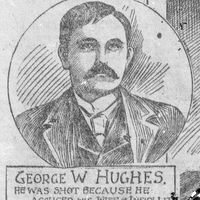
The last slice of scandal came out in a third trial. A witness, J. L. Carman (a long-standing blacksmith in Greer), described a gathering around the dying man. Someone commented that those around the bed were friends, but George made “emphatic dissent” saying that one in the group had been the cause of all the trouble — and charged that man with unfaithful conduct. This was apparently the highly-respected Dr. H. V. Westmoreland, who George said “violated his oath as a brother Mason.” While a report out of Atlanta said this “created a sensation” in the courtroom, a South Carolina paper said the story was “quite well known in the community.” This point became evident on the recent discovery of a Charles Drace glass negative, in which he had taken a photograph of a newspaper clipping. Presumably from the Greer Observer, the clipping has a drawing of Mattie with the caption "On trial at Greenville SC for killing her husband," a drawing of the house with a star showing the room where the shooting happened, and a drawing of George with the caption "He was shot because he accused his wife of infidelity." While all of the newspaper coverage discussed earlier painted a clean picture of George as a mild man not participating in any of Mattie's arguments, it appears likely that this fateful argument was actually caused by him charging her with adultery.
______________________
The defense had four well-paid lawyers. After “three of the most sensational trials in the history of the county” each resulted in mistrial, the state finally took a nolle prosequi (in essence, “we give up”) and Mattie Hughes was turned loose.
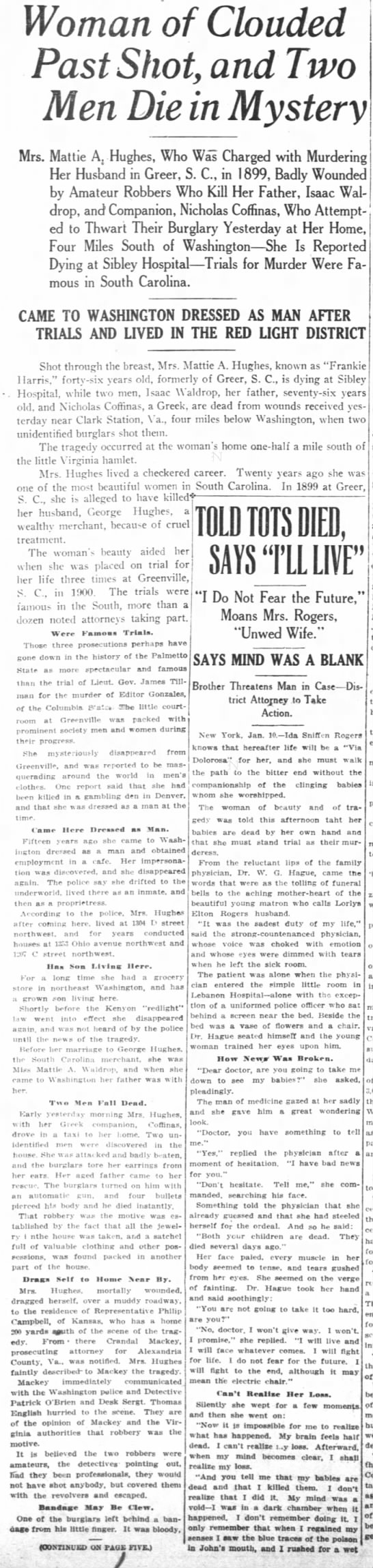
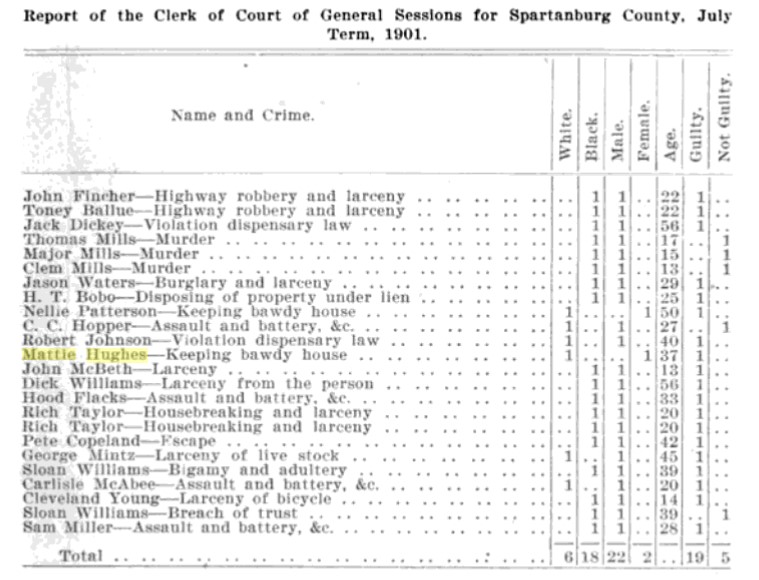
She ran a restaurant above the Hobbs-Henderson store on Main Street in Greenville, but it was not long before she was indicted for selling whiskey there. She moved to her hometown of Spartanburg, where she ran another restaurant and “made a great deal of money and trouble.” Her father joined her in Spartanburg, but in June 1900 he left town to avoid trial for selling whiskey. One week later she also disappeared to avoid her own liquor sales charges, but must have returned; in July 1901 she was found guilt of running a “bawdy house” (brothel) and then in September put on trial for multiple charges of selling liquor. But again she did not show up for the trial. A week before, she sold her restaurant and was seen walking around town in men’s clothing. She threatened the police chief, then skipped town in a $15 men’s suit with $2,000 in her pocket. Reports had her in Charlotte, Charleston, New York and Colorado before she landed in Washington, D.C.; by that time, she was living under the alias “Frankie Harris.” In Washington, she dressed as a man and obtained employment in a cafe. Her ruse was soon uncovered; she drifted into the underworld. She was arrested again in 1911, as Frankie Harris, for keeping a bawdy house which turned out to be a chain of three bordellos. After that business was shut down, she disappeared.
South Carolina papers reported that her end came on January 10, 1915. At age 46, Mattie Hughes came home to find “amateur robbers” inside; they took her jewelry, then beat her and shot her in the chest. The robbers then killed her father, Isaac, and her companion Nicholas Coffinas. The Keowee Courier reported: “Mrs. Hughes, mortally wounded, dragged herself, bleeding, over a muddy roadway to the home of Congressman Philip Campbell, of Kansas.” She was taken to a hospital and died within two days...
...except that her death was a reporter’s assumption, and turned out to be in error. On January 12, a Washington, D.C. paper noted that early reports were incorrect; she had not been shot after all, though her skull had been fractured and her face badly cut. She was expected to fully recover.
Little is known about her life after the attack, except for this: she lived another quarter of a century. Mattie died Dec. 6, 1941, in a Washington, D.C. psychiatric facility called St. Elizabeth’s Hospital. She was buried in Oakwood Cemetery, Falls Church, Virginia.
The Hughes’ son, Leo, became a successful manager of personnel for a coal company in West Virginia; he fathered 10 children, and lived to the age of 83.