Upstate medical history overview
- Title
- Upstate medical history overview
- Accession Number
- 2023.75.1
- Accession Date
- 13 April 2023
- Accession Creator
- David Lovegrove
- Depositor
- Found in Collection
- Description
- An anonymously authored history of medical practitioners in the Greater Greenville area which was most likely written around the time of the construction of the Allen Bennett hospital. The accuracy of this document cannot be guaranteed.
- Creator
- unknown; likely a former GHM volunteer
- Format
- photocopied document
- Storage Location
- General Archive Box #1 Folder #13
- Text
-
[page 1]
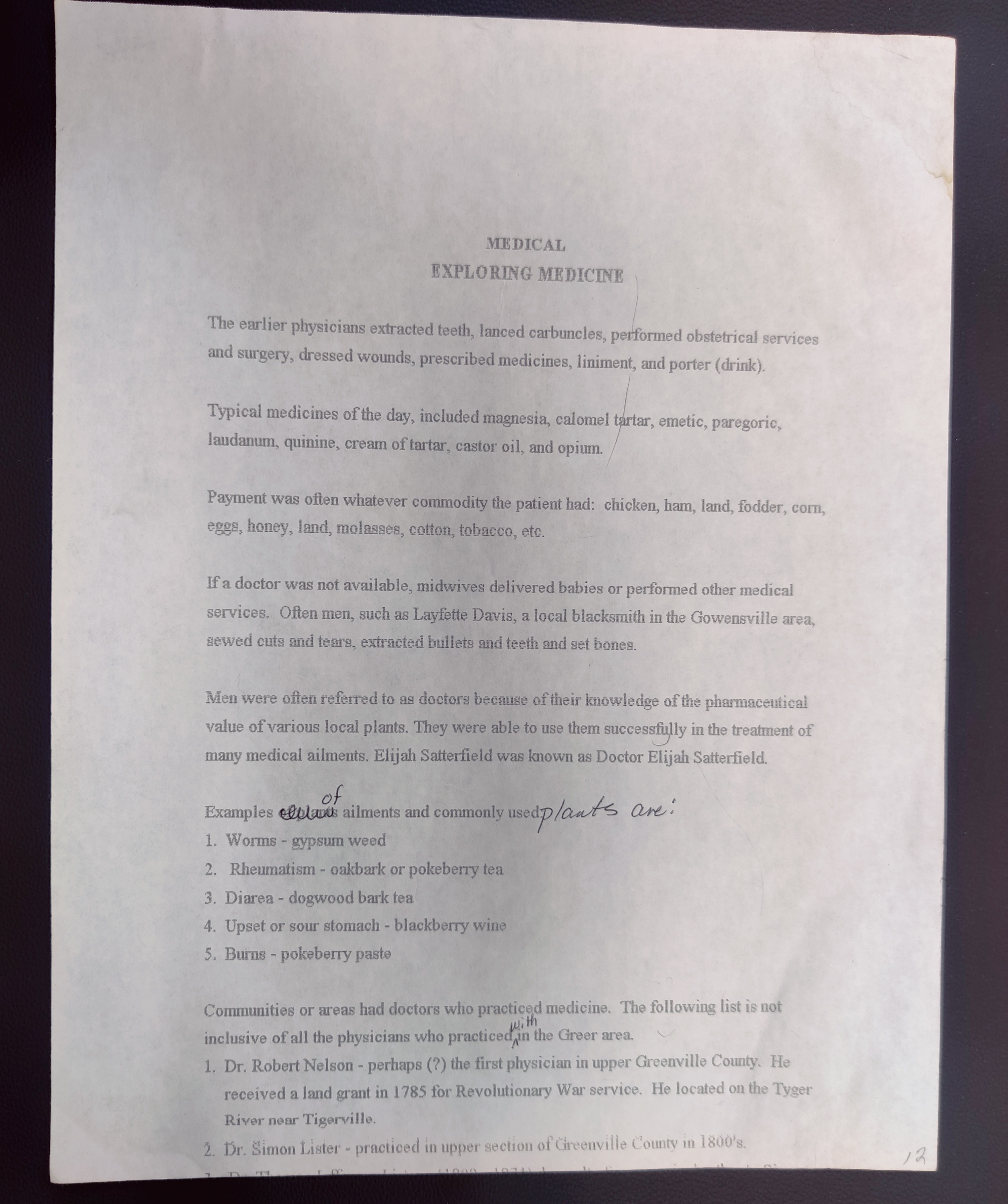
Medical
Exploring Medicine
The earlier physicians extracted teeth, lanced carbuncles, performed obstetrical services and surgery, dressed wounds, prescribe medicines, liniment, and porter (drink).
Typical medicines of the day, included magnesia, calomel tartar, emetic paregoric, laudanum, quinine, cream of tartar, castor oil, and opium.
Payment was often whatever commodity the patient had: chicken, ham, land, fodder, corn, eggs, honey, land, molasses, cotton, tobacco, etc.
If a doctor was not available, midwives delivered babies or preformed other medical services. Often men, such as Layfette Davis, a local blacksmith in the Gowensville area, sewed cuts and tears, extracted bullets and teeth and set bones.
Men were often referred to as doctors because of their knowledge of the pharmaceutical value of various local plants. They were able to use them successfully in the treatment of many medical ailments. Elijah Satterfield was known as Doctor Elijah Satterfield.
Examples of ailments and commonly used plants are:
1. Worms - gypsum weed
2. Rheumatism - oakbark or pokeberry tea
3. Diarea - dogwood bark tea
4. Upset or sour stomach - blackberry wine
5. Burns - pokeberry paste
Communities or areas had doctors who practiced medicine. The following list is not inclusive of all the physicians who practiced within the Greer area.
1. Dr. Robert Nelson - perhaps (?) the first physician in upper Greenville county. He received a land grant in 1785 for Revolutionary War service. He located on the Tyger River near Tygerville.
2. Dr. Simon Lister - practiced in upper section of Greenville County in 1800's.
[page 2]
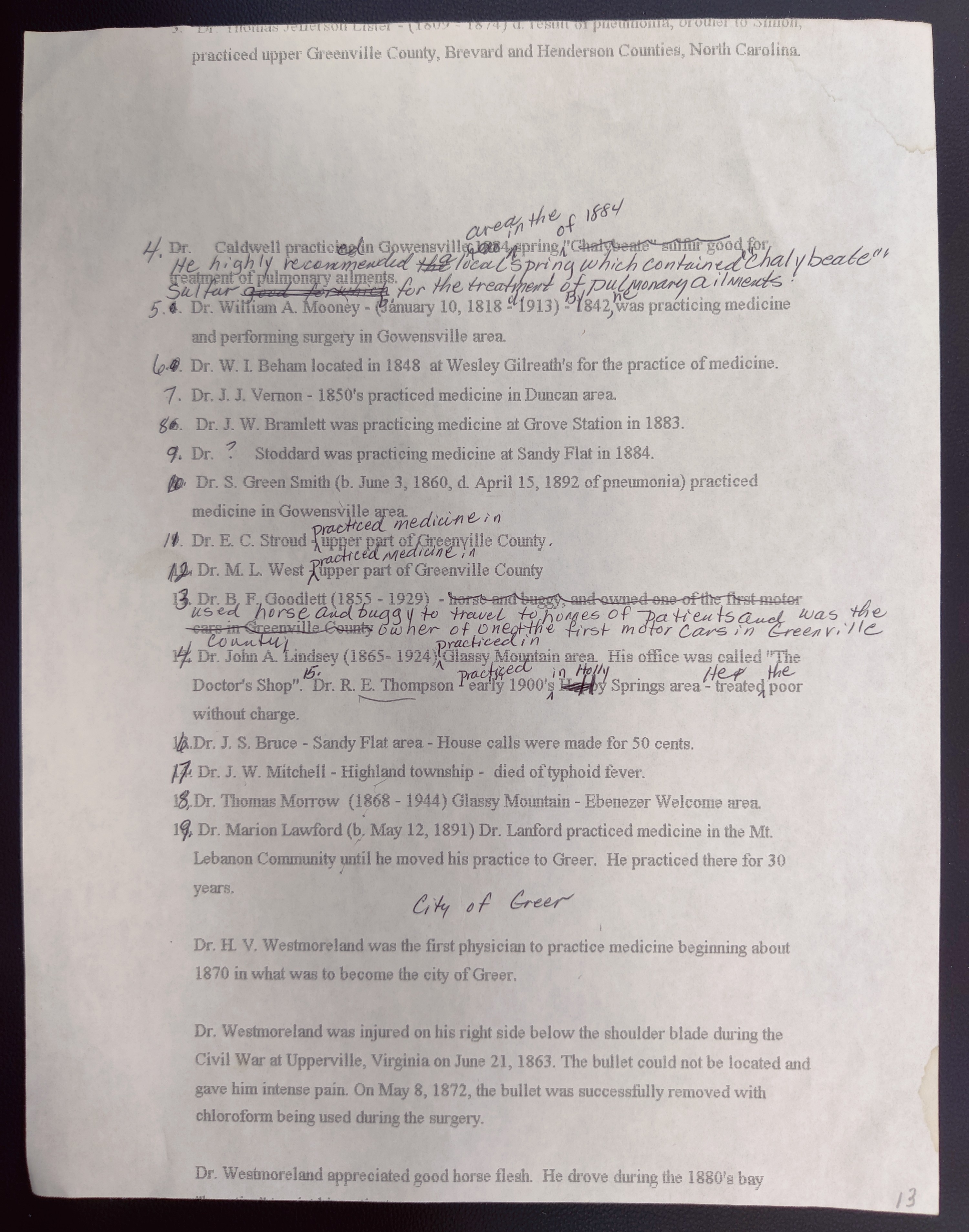
3. Dr. Thomas Jefferson Lister - (1809-1874) d. result of pneumonia, brother to Simon, practiced upper Greenville County, Brevard and Henderson Counties, North Carolina.
4. Dr. Caldwell practiced in Gowensville area in 1884. He highly recommended a local spring which contained "chalybeate" sulfur for the treatment of pulmonary ailments.
5. Dr. William A. Mooney - (January 10, 1818-1913) - 1842, he was practicing medicine and preforming surgery in Gowensville area.
6. Dr. W. I. Beham located in 1848 at Wesley Gilreath's for the practice of medicine.
7. Dr. J. J. Vernon - 1850's practiced medicine in Duncan area.
8. Dr. J. W. Bramlett was practicing medicine at Grove Station in 1883.
9. Dr. ? Stoddard was practicing medicin at Sandy Flat in 1884.
10. Dr. S. Green Smith (b. June 3, 1860, d. April 15, 1892 of pneumonia) practiced medicine in Gowensville area.
11. Dr. E. C. Stroud - practiced medicine in upper part of Greenville County
12. Dr. M. L. West - practiced medicine in upper part of Greenville County
13. Dr. B. F. Goodlett (1855-1929) - used horse and buggy to travel to homes of patients and was the county owner of one of the first motorcars in Greenville
14. Dr. John A. Lindsey (1865-1924) practiced in Glassy Mountain area. His office was called "The Doctor's Shop".
15. Dr. R. E. Thompson practiced early 1900's in Holly Springs area - He treated the poor without charge.
16. Dr. J. S. Bruce - Sandy Flat area - House called were made for 50 cents.
17. Dr. J. W. Mitchell - Highland township - died of typhoid fever.
18. Dr. Thomas Morrow (1868-1944) Glassy Mountain - Ebenezer Welcome area.
19. Dr. Marion Lawford (b. May 12, 1891) Dr. Lanford practiced medicine in the Mt. Lebanon Community until he moved his practice to Greer. He practiced there for 30 years.
City of Greer
Dr. H. V. Westmoreland was the first physician to practice medicine beginning about 1870 in what was to become the city of Greer.
Dr. Westmoreland was injured on his right side below the shoulder blade during the Civil War at Upperville, Virginia on June 21, 1863. The bullet could not be located and gave him intense pain. On May 8, 1872, the bullet was successfully removed with chloroform being used during the surgery.
Dr. Westmoreland appreciated good horse flesh. he drove during the 1880's bay
[page 3]
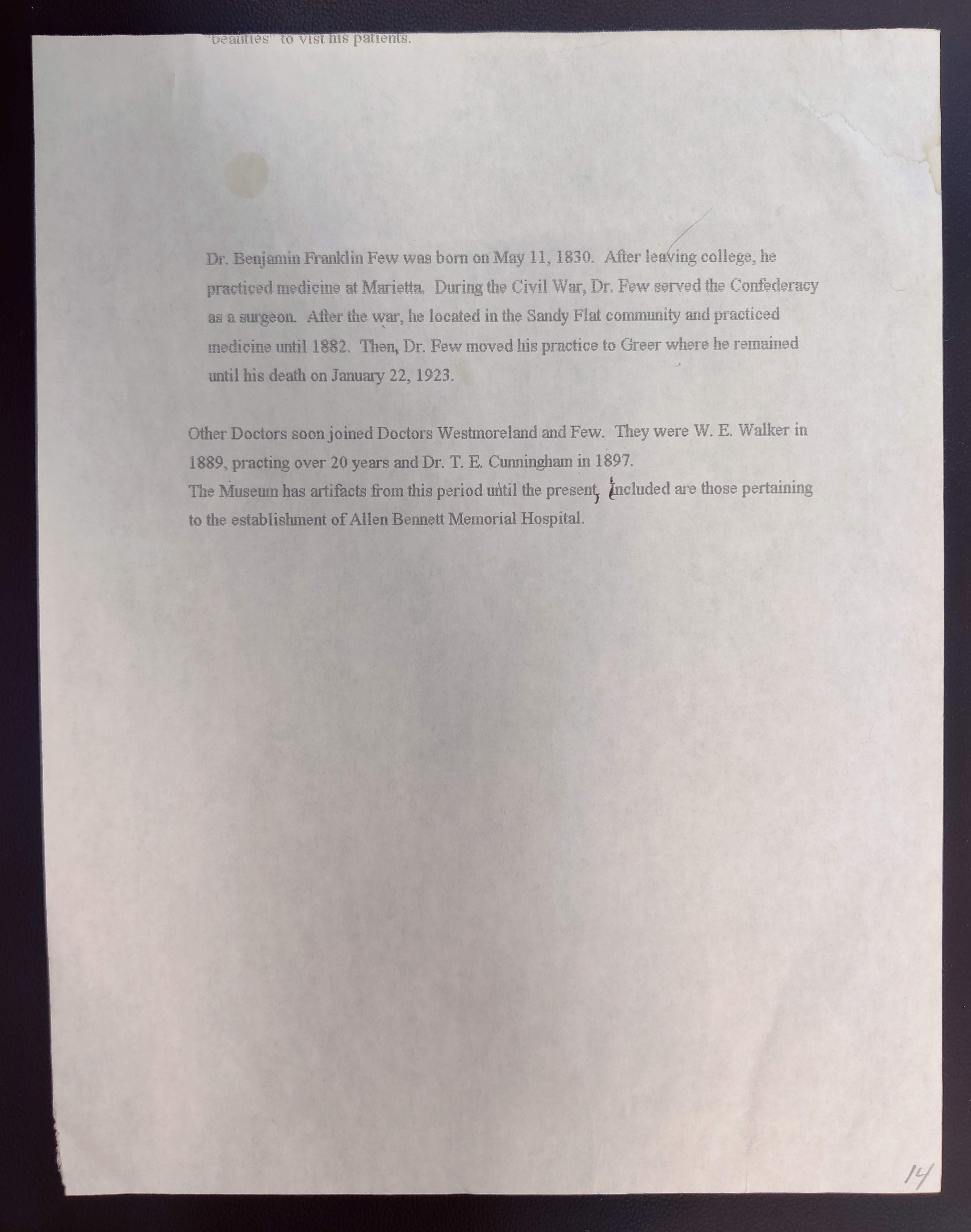
"beauties" to see his parents.
Dr. Benjamin Franklin Few was born on May 11, 1830. After leaving college, he practiced medicine at Marietta. During the Civil War, Dr. Few served the Confederacy as a surgeon. After the war, he located in the Sandy Flat community and practiced medicine until 1882. Then, dr. Few moved his practice to Greer where he remained until his death on January 22, 1923.
Other doctors soon joined Doctors Westmoreland and Few. They were W. E. Walker in 1889, practicing over 20 years and Dr. T. E. Cunningham in 1897. The Museum has artifacts from this period until the present. Included are those pertaining to the establishment of Allen Bennett Memorial Hospital.
- Item sets
- GHM: archive
Part of Upstate medical history overview