-
Title
-
Greer history from Greer Citizen, Dec. 7, 1966
-
Accession Number
-
2023.73.1
-
Accession Date
-
11 April 2023
-
Accession Creator
-
David Lovegrove
-
Depositor
-
Found in Collection
-
Date
-
December 7, 1966
-
Format
-
newspaper clipping
-
Storage Location
-
General Archive Box #1 Folder #15
-
Text
-
OFF THE RECORD
BY EDD BURCH
OF PEOPLE YOU KNOW
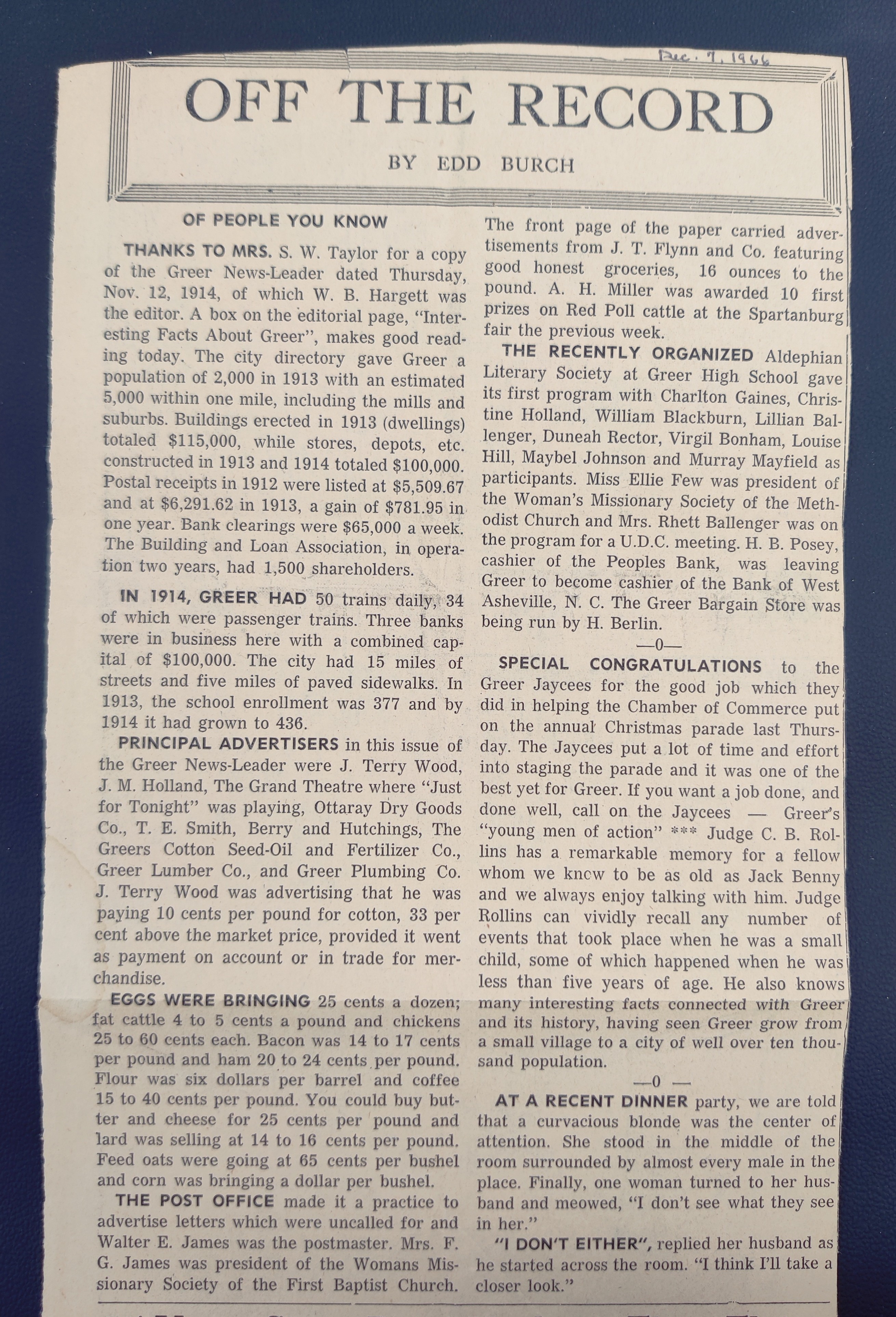
THANKS TO MRS. S. W. Taylor for a copy of the Greer News-Leader dated Thursday, Nov. 12, 1914, of which W. B. Hargett was the editor. A box on the editorial page, "Interesting Facts About Greer", makes good reading today. The city directory gave Greer a population of 2,000 in 1913 with an estimated 5,000 within one mile, including the mills and suburbs. Buildings erected in 1913 (dwellings) totaled $115,000, while stores, depots, etc. constructed in 1913 and 1914 totaled $100,000. Postal receipts in 1912 were listed at $5,509.67 and at $6,291.62 in 1913, a gain of $781.95 in one year. Bank clearings were $65,000 a week. The Building and Loan Association, in operation two years, had 1,500 shareholders.
IN 1914, GREER HAD 50 trains daily, 34 of which were passenger trains. Three banks were in business here with a combined capital of $100,000. The city had 15 miles of streets and five miles of paved sidewalks. In 1913, the school enrollment was 377 and by 1914 it had grown to 436.
PRINCIPAL ADVERTISERS in this issue of the Greer News-Leader were J. Terry Wood, J. M. Holland, The Grand Theatre where "Just for Tonight" was playing, Ottaray Dry Goods Co., T. E. Smith, Berry and Hutchings, The Greers Cotton Seed-Oil and Fertilizer Co., Greer Lumber Co., and Greer Plumbing Co. J. Terry Wood was advertising that he was paying 10 cents per pound for cotton, 33 per cent above the market price, provided it went as payment on account or in trade for merchandise.
EGGS WERE BRINGING 25 cents a dozen; fat cattle 4 to 5 cents a pound and chickens 25 to 60 cents each. Bacon was 14 to 17 cents per pound and ham 20 to 24 cents per pound. Flour was six dollars per barrel and coffee 15 to 40 cents per pound. You could buy butter and cheese for 25 cents per pound and lard was selling at 14 to 16 cents per pound. Feed oats were going at 65 cents per bushel and corn was bringing a dollar per bushel.
THE POST OFFICE made it a practice to advertise letters which were uncalled for and in her." Walter E. James was the postmaster. Mrs. F. G. James was president of the Womans Missionary Society of the First Baptist Church. The front page of the paper carried advertisements from J. T. Flynn and Co. featuring good honest groceries, 16 ounces to the pound. A. H. Miller was awarded 10 first prizes on Red Poll cattle at the Spartanburg fair the previous week.
THE RECENTLY ORGANIZED Aldephian Literary Society at Greer High School gave its first program with Charlton Gaines, Christine Holland, William Blackburn, Lillian Ballenger, Duneah Rector, Virgil Bonham, Louise Hill, Maybel Johnson and Murray Mayfield as participants. Miss Ellie Few was president of the Woman's Missionary Society of the Methodist Church and Mrs. Rhett Ballenger was on the program for a U.D.C. meeting. H. B. Posey, cashier of the Peoples Bank, was leaving Greer to become cashier of the Bank of West Asheville, N. C. The Greer Bargain Store was being run by H. Berlin.
SPECIAL CONGRATULATIONS to the Greer Jaycees for the good job which they did in helping the Chamber of Commerce put on the annual Christmas parade last Thurs- day. The Jaycees put a lot of time and effort into staging the parade and it was one of the best yet for Greer. If you want a job done, and done well, call on the Jaycees -- Greer's "young men of action" *** Judge C. B. Rollins has a remarkable memory for a fellow! whom we know to be as old as Jack Benny and we always enjoy talking with him. Judge Rollins can vividly recall any number of events that took place when he was a small - child, some of which happened when he was less than five years of age. He also knows many interesting facts connected with Greer and its history, having seen Greer grow from a small village to a city of well over ten thou sand population.
AT A RECENT DINNER party, we are told that a curvacious blonde was the center of attention. She stood in the middle of the room surrounded by almost every male in the place. Finally, one woman turned to her husband and meowed, "I don't see what they see
"I DON'T EITHER", replied her husband as he started across the room. "I think I'll take a closer look."